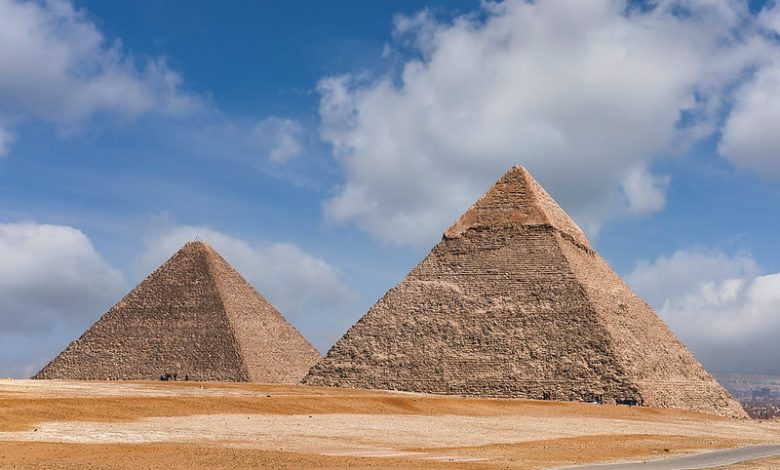
An Exhaustive Technical Analysis of Ancient Precision and 2026 Megastructure Potential
2.3 Million Blocks Used
6 Million Tons Total Mass
0.05° Alignment Error
20 Years Build Time
I. The Mathematics of Eternity: Planning & Geometry
The Great Pyramid of Giza is not just a tomb; it is a mathematical cipher. Constructed for Pharaoh Khufu (Cheops) around 2580 BCE, it remained the tallest man-made structure on Earth for over 3,800 years. Its construction required a level of logistical precision that modern architects still struggle to replicate without heavy machinery.
The base of the pyramid is aligned to True North with an accuracy within three-sixtieths of a degree. To achieve this, ancient astronomers likely used the simultaneous transit of stars (such as Kochab and Mizar in the Little and Big Dippers). By tracking the midpoint of these stars’ circular paths, they established a perfect North-South meridian.
II. Geotechnical Logistics: Moving 6 Million Tons
The pyramid is composed of three primary stone types, each requiring a different logistical chain:
Local Limestone: 98% of the mass. Quarried directly from the Giza plateau.
Tura Limestone: The white, reflective casing. Transported 15km across the Nile via specialized barges.
Aswan Granite: Used for the King’s Chamber. These 80-ton monoliths were moved 800km downstream.
The Wet Sand Friction Secret: Ancient Egyptians solved the problem of moving 2.5-ton blocks on wooden sledges by pouring water on the sand. Modern tribology (the study of friction) confirms that a specific amount of moisture creates liquid bridges between sand grains, reducing the pulling force required by 50%.
III. Structural Innovations: Relieving the Weight
The most critical engineering challenge was the King’s Chamber. Located deep within the pyramid, it had to support millions of tons of stone pressing down from above.
Stress-Relieving Chambers
To prevent the granite ceiling of the King’s Chamber from cracking, engineers built five Relieving Chambers above it. These air-filled voids, topped with a gabled (pointed) roof, redirect the vertical pressure of the pyramid’s apex outward into the surrounding core masonry. This is a primitive yet effective form of load-path redirection.
IV. The Modern Rebuild: “Pyramid 2.0” (2026)
If we were to reconstruct the Great Pyramid today, we would not use ramps. We would utilize Automated Modular Assembly.
1. Materials: UHPC vs. Geopolymers
While the original used natural stone, a modern version would use Ultra-High-Performance Concrete (UHPC) or Geopolymer Limestone. Geopolymers allow us to “cast” stone on-site using a chemical reaction that mimics natural lithification, providing a seamless finish that would last 10,000 years.
Density Comparison: Natural Limestone: ~2,500 kg/m³ Modern UHPC: ~2,800 kg/m³ (with 10x higher tensile strength)
2. Height and Scale
Specification
Original (2580 BCE)
Modern Rebuild (2026)
Max Height
146.6 Meters
800+ Meters (Pyramid Skyscraper)
Construction Method
Manual Ramps/Sledges
A.I. Tower Cranes & 3D Printing
Foundation
Bedrock Leveling
Deep Pile Foundations (150m deep)
V. Cost-Benefit & Economic Impact
Building a faithful 1:1 replica of the Great Pyramid today would cost approximately $1.2 Billion to $5 Billion USD. However, if we built a Functional Pyramid—one that serves as a vertical city or a massive solar power plant—the cost could exceed $15 Billion.
The Solar Casing
A modern pyramid could be clad in Transparent Solar Glass. With a surface area of over 100,000 m², the pyramid would act as a massive energy harvester, providing enough electricity to power the entire Giza district. This turns an ancient monument into a Net-Zero Megastructure.
VI. Workforce Transformation
The original build required 20,000 skilled laborers over 20 years. In 2026, we would require fewer than 2,000 people, mostly **Systems Architects** and **Drone Operators**. The actual “heavy lifting” would be performed by **Autonomous Gantry Robots** moving on a temporary rail system built into the pyramid’s tiers.
VII. Conclusion: The Blueprint of Humanity
The Great Pyramid of Giza remains the ultimate benchmark of engineering. Whether built with copper chisels or 3D-printing nozzles, the pyramid shape remains the most stable structure in geometry. As we look toward building on Mars or the Moon, the Giza plateau offers the original blueprint for long-term survival and monumental permanence.
Tech Gurug is a leading Technology Journal. Our Expert Mr Nishant Patar have decade of experience in Tech World. He and other experts are sharing their knowledge here. Also, see our Youtube Channel Tech Gurug and Yatra Gurug. Comment Guidelines : Genuine Name, No Links in comment, No Flooding Comments and Genuine Comment or your comment will be deleted or get ban from this site.