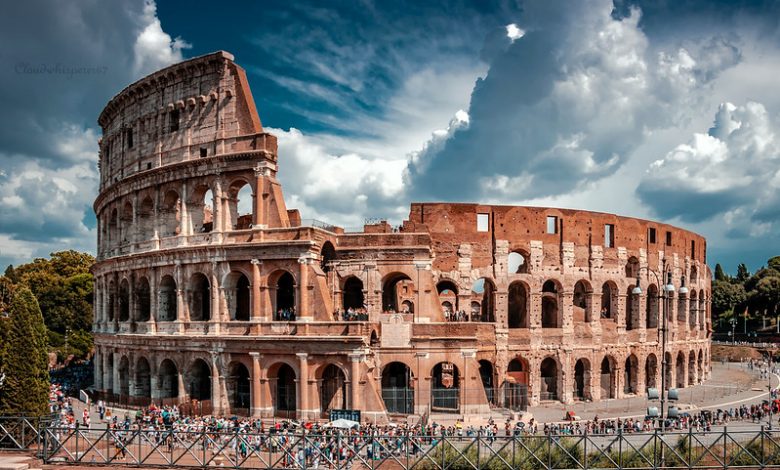
The Flavian Amphitheatre: A Masterclass in Structural Physics
The Definitive Guide to Ancient Engineering and Modern Re-Imagining
1.1 Million Tons Estimated Weight
100,000 m³ Travertine Stone
80 Arched Entrances
10 Years Construction Time
I. Theoretical Foundation: Why the Oval?
The Colosseum, or Flavian Amphitheatre, represents the pinnacle of Roman utilitarian design. Unlike Greek theaters, which were carved into natural hillsides, the Colosseum is a free-standing structure. To achieve this, Roman engineers had to master the physics of the Oval. A circular building creates a single central focal point, but an elliptical shape provides better sightlines for gladiatorial combat, which is linear in nature. Furthermore, the ellipse allowed for the “Vomitoria”—the sophisticated network of corridors that could empty 80,000 people in less than 20 minutes.
II. Geotechnical Engineering: Building on a Lake
One of the most audacious decisions was the location. Emperor Vespasian chose the site of Nero’s former artificial lake. This presented a catastrophic risk of sinking.
Roman engineers excavated 12 meters of silt and clay. In its place, they poured a massive annular (ring-shaped) foundation of concrete. This raft was 13 meters wide and 6 meters thick. By creating a continuous ring of concrete, they ensured that the building’s weight was distributed evenly, preventing “differential settlement” that would have caused the walls to crack and collapse under their own immense gravity.
III. Material Science: The Roman Secret
The Colosseum is not just stone; it is an early example of “Composite Construction.”
Material
Physics Property
Structural Role
Travertine
High Compressive Strength
Main outer piers and load-bearing skeleton.
Tuff
Lightweight / Elastic
Inner radial walls; absorbs seismic energy.
Roman Concrete
Hydraulic Setting
The “glue” of the vaults and foundation.
Iron Clamps
Tensile Strength
Joining 300 tons of iron to stone without mortar.
The Pozzolana Secret: Roman concrete used volcanic ash (Pozzolana) from Mount Vesuvius. This ash reacts with lime and water to create a crystalline structure that actually grows stronger over time, even when exposed to water. This is why the foundation remains stable 2,000 years later.
IV. The Arch and Vault System: Distributing the Load
The Colosseum is essentially a complex “skeleton” of 80 radial walls and concentric rings. The weight of the upper tiers is channeled through Barrel Vaults and Groin Vaults down to the massive travertine piers.
The Centring Technique
To build these arches, Romans used “Centring”—temporary wooden frames. Once the keystone was placed at the apex of the arch, the weight was pushed outwards into the piers, and the wooden frame could be removed and reused. This allowed for a “Modular Construction” style that significantly accelerated the building timeline.
V. The Hypogeum: An Underground Mechanical Engine
The arena floor was not solid ground; it was a wooden platform covered in sand (harena). Beneath it sat the Hypogeum, a two-story labyrinth of tunnels. This was the world’s first large-scale theatrical “Backstage.”
Man-Powered Elevators: 28 “lifts” operated by winches and pulleys to raise lions and tigers directly into the arena.
Hydraulic Drainage: A sophisticated network of sewers that could drain rain or blood into the nearby Tiber River.
VI. Rebuilding the Colosseum: The “Colosseum 2.0” Blueprint
If we were to utilize 2026 technology to recreate this monument, we would no longer be limited by the crushing weight of stone. We would move from Gravity-Based Support to Tensile-Based Support.
1. The Foundation: Deep Bedrock Piles
Instead of a concrete raft, we would use robotic boring machines to drive Steel-Cased Concrete Piles 100 meters deep into the bedrock. We would utilize Base Isolation—placing the building on massive lead-rubber bearings that allow the structure to slide during an earthquake rather than vibrate.
2. Materials: UHPC and Graphene
Modern Ultra-High-Performance Concrete (UHPC) has a compressive strength of 30,000 psi, compared to the Romans’ 3,000 psi.
Force (F) = Pressure (P) × Area (A) With UHPC, we can reduce pier thickness by 70%, creating more space for amenities.
By reinforcing the concrete with Graphene nanofibers, we eliminate the need for traditional rebar, creating a structure that is virtually immune to rust and chemical degradation.
3. The Velarium 2.0: Active Smart Roof
The original Velarium was a cloth awning operated by sailors. A modern version would use ETFE (Ethylene Tetrafluoroethylene)—the same lightweight material used in the Beijing Water Cube. This roof would be “active,” with integrated solar cells and the ability to change transparency based on the sun’s position to maintain a perfect 22°C internal temperature.
VII. Comparing the Eras: Ancient vs. Modern
Feature
Ancient Roman (80 CE)
Modern Engineering (2026)
Max Height
48 Meters
150 Meters (Feasible)
Construction Force
30,000 Slaves/Artisans
2,000 Engineers/Robotic Systems
Lifespan
2,000+ Years
Indefinite (with self-healing concrete)
Safety
Exit in 20 mins
AI-controlled evacuation in 8 mins
VIII. Sustainable Legacy: The Green Colosseum
A modern Colosseum would be a “Net-Zero” facility. The massive surface area of the outer arches would be fitted with Transparent Solar Glass, turning the building into a giant power plant. Rainwater would be harvested from the retractable roof, filtered through the Hypogeum’s original sewer paths (now modernized), and reused for the facility’s cooling systems.
IX. Conclusion: The Eternal Engineering
The Colosseum remains a testament to the fact that engineering is the art of “Doing for one dollar what any fool can do for two.” The Romans used the materials they had beneath their feet to build something that defied time. Rebuilding it today wouldn’t just be about size; it would be about integrating Smart Infrastructure into a design that has already proven its worth for two millennia.
Tech Gurug is a leading Technology Journal. Our Expert Mr Nishant Patar have decade of experience in Tech World. He and other experts are sharing their knowledge here. Also, see our Youtube Channel Tech Gurug and Yatra Gurug. Comment Guidelines : Genuine Name, No Links in comment, No Flooding Comments and Genuine Comment or your comment will be deleted or get ban from this site.